
Why we miss GPS errors: The role of self-efficacy and cognitive bias
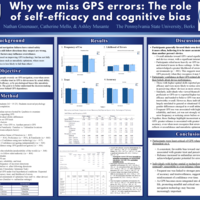
This study examined cognitive and individual factors that contribute to overreliance on GPS navigation. Participants evaluated the accuracy, trustworthiness, and error likelihood of their own versus others' devices across familiar and unfamiliar environments while completing measures of spatial ability, technological proficiency, and self-efficacy. Results showed that users judged their own GPS as more accurate and trustworthy, especially in unfamiliar environments. These findings indicate that cognitive bias, rather than skill or experience, drives excessive GPS reliance.
The related URL, listed in the metadata, corresponds to the content intended to be accessed via the QR code on the poster.
Files
-
View: ACCESSIBLE_VERSION_MusanteAshley_Poster.pdf
Download: ACCESSIBLE_VERSION_MusanteAshley_Poster.pdf
Metadata
Work Title Why we miss GPS errors: The role of self-efficacy and cognitive bias Access Creators - Ashley Mary Musante
- Nathan Greenauer
- Catherine Mello
Keyword - Unrealistic optimism
- Cognitive psychology
- Navigation
- Self-efficacy
- Bias
- Technology
License CC BY-SA 4.0 (Attribution-ShareAlike) Work Type Poster Publication Date May 2026 Related URLs Deposited June 17, 2026 Versions
Analytics
Collections
Work History
Version 1
published-
Created
-
Updated
-
Updated Keyword, Related URLs, Description, and 1 more Show ChangesKeywordRelated URLs
- Unrealistic optimism, Cognitive psychology, Navigation, Self-efficacy, Bias, Technology
Description- https://gpserrors.my.canva.site/why-we-miss-gps-errors-the-role-of-self-efficacy-and-cognitive-bias/
Publication Date- This study examined cognitive and individual factors that contribute to overreliance on GPS navigation. Participants evaluated the accuracy, trustworthiness, and error likelihood of their own versus others' devices
- across familiar and unfamiliar environments while completing measures of spatial ability, technological proficiency, and self-efficacy. Results showed that users judged their own GPS as more accurate and trustworthy,
- especially in unfamiliar environments. These findings indicate that cognitive bias, rather than skill or experience, drives excessive GPS reliance.
- 2026-05
-
Added Creator Ashley Mary Musante
-
Added Creator Nathan Greenauer
-
Added Creator Catherine Mello
-
Added
MusanteAshley_Poster.pdf -
Updated License Show ChangesLicense
- https://creativecommons.org/licenses/by-sa/4.0/
-
Published
-
Updated
Version 2
published-
Created
-
Deleted
MusanteAshley_Poster.pdf -
Added
ACCESSIBLE_VERSION_MusanteAshley_Poster.pdf -
Published
-
Updated Description Show ChangesDescription
- This study examined cognitive and individual factors that contribute to overreliance on GPS navigation. Participants evaluated the accuracy, trustworthiness, and error likelihood of their own versus others' devices
- across familiar and unfamiliar environments while completing measures of spatial ability, technological proficiency, and self-efficacy. Results showed that users judged their own GPS as more accurate and trustworthy,
especially in unfamiliar environments. These findings indicate that cognitive bias, rather than skill or experience, drives excessive GPS reliance.- especially in unfamiliar environments. These findings indicate that cognitive bias, rather than skill or experience, drives excessive GPS reliance.
- *The related URL corresponds to the content intended to be accessed via the QR code on the poster.*
-
Updated Description Show ChangesDescription
- This study examined cognitive and individual factors that contribute to overreliance on GPS navigation. Participants evaluated the accuracy, trustworthiness, and error likelihood of their own versus others' devices
- across familiar and unfamiliar environments while completing measures of spatial ability, technological proficiency, and self-efficacy. Results showed that users judged their own GPS as more accurate and trustworthy,
- especially in unfamiliar environments. These findings indicate that cognitive bias, rather than skill or experience, drives excessive GPS reliance.
*The related URL corresponds to the content intended to be accessed via the QR code on the poster.*- *The Related URL, listed in the Metadata, corresponds to the content intended to be accessed via the QR code on the poster.*
-
Updated Description Show ChangesDescription
- This study examined cognitive and individual factors that contribute to overreliance on GPS navigation. Participants evaluated the accuracy, trustworthiness, and error likelihood of their own versus others' devices
- across familiar and unfamiliar environments while completing measures of spatial ability, technological proficiency, and self-efficacy. Results showed that users judged their own GPS as more accurate and trustworthy,
- especially in unfamiliar environments. These findings indicate that cognitive bias, rather than skill or experience, drives excessive GPS reliance.
*The Related URL, listed in the Metadata, corresponds to the content intended to be accessed via the QR code on the poster.*- *The related URL, listed in the metadata, corresponds to the content intended to be accessed via the QR code on the poster.*