
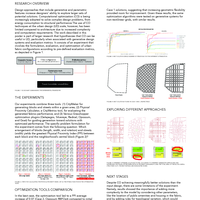
Urban Design Optimization
Design approaches that include generative and parametric features increase designers’ ability to explore larger sets of potential solutions. Computational optimization (CO) is being increasingly adopted to solve complex design problems, from energy consumption to structural performance.The use of CO techniques at the urban design (UD) scale, however, has been limited compared to architecture due to increased complexity and computation requirements. The work described in this poster is part of larger research that hypothesizes that CO can be useful in UD, particularly when associated with generative design systems and evaluation metrics. It consists of an experiment that involves the formulation, evaluation, and optimization of urban fabric configurations according to pre-defined evaluation metrics.
Files
-
Metadata
Work Title Urban Design Optimization Subtitle A generative approach towards urban fabrics with improved walkability Access Creators - Fernando Lima
- Nathan Brown
- Jose M Pinto Duarte
Keyword - Urban design
- Transit-oriented development
- Computational design
- Generative design
License CC BY-NC 4.0 (Attribution-NonCommercial) Work Type Poster Publication Date September 23, 2021 Source - Fall 2021 Stuckeman Research Open House
Deposited February 23, 2022 Versions
Analytics
Collections
Work History
Version 1
published-
Created
-
Added Creator Fernando Lima
-
Added Creator Nathan Brown
-
Added Creator Jose M Pinto Duarte
-
Added
Urban Lima.pdf -
Updated License Show ChangesLicense
- https://creativecommons.org/licenses/by-nc/4.0/
-
Published
-
Updated
-
Updated
Version 2
published-
Created
-
Deleted
Urban Lima.pdf -
Added
ACCESSIBLE_VERSION_Urban Lima.pdf -
Published